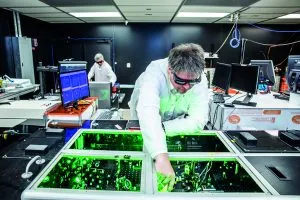
Aligning laser beams within laser systems (Source: TAU Systems)
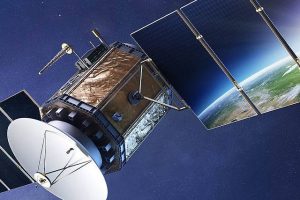
The space industry faces an invisible enemy that threatens every mission from Earth orbit to Mars and beyond: cosmic radiation.
Space radiation
Modern electronics face unprecedented vulnerability to space radiation. As transistors shrink below 10nm, even low-energy particles can cause single-event effects (SEEs). These are transient or permanent malfunctions triggered by individual particle strikes. SEEs range from temporary bit flips to complete device failure and they are becoming more frequent as chip density increases.
The challenge grows more acute as we deploy advanced computing capabilities in space. AI and machine-learning systems are essential for autonomous spacecraft navigation, real-time scientific analysis and communications. They demand powerful processors with billions of transistors and each represents a potential failure point. Without rigorous testing these systems cannot be trusted in radiation environments thousands of times harsher than Earth’s surface.
Traditional radiation testing relies on massive particle accelerator facilities, kilometres long with the infrastructure of a small town to operate them, and consuming enormous amounts of power.
Laser-driven accelerator
Laser-driven accelerator technology reimagines radiation-testing infrastructure. Fast laser driven plasma accelerators are able to fit within shipping container-sized units, yet deliver performance comparable to conventional facilities occupying thousands of square feet. Focusing intense laser pulses onto plasma targets generates high-energy particle beams suitable for realistic radiation testing, with dramatically reduced size, cost and power consumption.
Each accelerator unit can provide 2,000 to 4,000 hours of annual beam time, effectively replacing or supplementing traditional facilities at a fraction of the capital and operational expense. Multiple units can be deployed regionally or on-site at aerospace facilities; this distributed approach transforms radiation testing from a scarce, centralised resource into an accessible, scalable capability.
The economics are compelling. Where traditional accelerator facilities require investments exceeding $100m and millions of dollars in ongoing operational costs annually, more compact systems are able to reduce both capital expenditure and operating expenses by orders of magnitude.
DARPA’s ASSERT programme
The DARPA (the Defense Advanced Research Projects Agency) ASSERT (Accelerated Single Event Testing for Radiation Tolerance) programme explores new methodologies to characterise radiation effects in advanced electronics. In collaboration with Nasa’s Jet Propulsion Laboratory, the Aerospace Corporation and industry research partners such as TAU Systems, the initiative focuses on developing electron-based SEE (eSEE) testing.
By using tunable electron beams engineers can achieve finer energy control and spatial precision, enabling faster and potentially more repeatable test cycles. Current research is assessing how well these electron-induced events correlate with ion-induced failures, a critical step in establishing confidence for qualification use.
In healthcare compact laser-driven particle sources are being developed for cancer therapies, potentially bringing advanced radiation treatment capabilities to regional hospitals rather than limiting them to major medical centres. The technology also supports chip production processes, particularly for extreme ultraviolet lithography and advanced materials characterisation.
Fast compact laser-driven plasma accelerators ensure every chip, every sensor and every processor can withstand the harsh radiation environment beyond Earth’s protective magnetosphere.