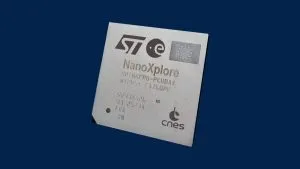
The radiation-hardened SoC FPGA combines a multi-core processor with programmable hardware on a single chip. It has been designed for low- and medium-earth orbit constellations and will be used in satellite equipment systems, including Galileo, Copernicus missions. It is also potentially to be used for NASA’s Interface Region Imaging Spectrograph (IRIS) Small Explorer mission to study the sun’s chromosphere and transition region, said STMicro.
This is the first product qualified to the new European standard for microcircuits in flip-chip on organic substrate or plastic packages which transitions the industry away from more expensive ceramic packages.
The FPGA integrates a quad core Arm Cortex-R52 with 537k LUTs + 32Mb RAM for compute performance. This compute performance is required to process data directly in orbit (edge computing) to relieve transmission bottlenecks between space and the ground in low and medium Earth orbits.
It is built on STMicroelectronics’ 28nm FD-SOI digital technology which is energy-efficient and resistant to space radiation, and uses an advanced radiation hardening technology to enable the NG-Ultra to survive the thermal cycles, shocks, and vibrations of launch and long-term orbital life expected in space missions.
The FPGA has a TID (total ionising dose) tolerance of up to 50krad (Si) and resilence to single-event effects. Single event latch-up (SEL) immunity is tested up to 65 MeV·cm²/mg and single event upset (SEU) immunity is validated for LET (linear energy transfer) levels exceeding 60 MeV·cm²/mg.
The design also reduces component count and PCB complexity, while lowering total power consumption and project cost, adds NanoXplore.
Adaptive hardware allows for unlimited on-orbit reconfiguration, enabling operators to update functionality post-launch, adapt to evolving communication standards, or optimise the chip for different mission phases.
The FPGA can be used in on-board computers, data management and routing between sub-systems, image and video processing (real-time compression and encoding), software defined radio (SDR) and onboard autonomy (detection, recognition, supervision).
The NG-Ultra is also available as an evaluation kit.
NanoXplore has an R&D and design centre in Paris, Grenoble and Montpellier, and uses STMicroelectronics design, test and packaging facilities in France and Italy.
Space Forge claims first for orbital semiconductor manufacturing