Posted on 10th December 2019 | Modified on 23rd June 2025
Automotive Electronics, Embedded Systems, FPGA / PLD, Industrial Electronics, Internet of Things
Lattice has switched to 28nm FD-SOI (fully-depleted silicon-on-insulator) technology for a range of sram-based FPGAs intended for embedded vision and artificial intelligence processing in industrial, automotive and consumer systems. Although they are ram-based, and therefore need to boot from adjacent memory, the firm has found a way to get chip outputs enabled, set and stable within 3ms of power-up – allowing ...
Posted on 14th November 2019 | Modified on 23rd June 2025
Embedded Systems, Industrial Electronics, Memory
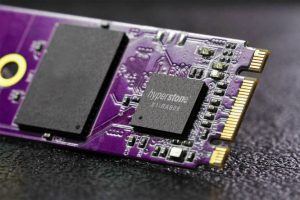
Hyperstone is aiming at reliable industrial flash with X1, a memory controller chip that can operate 3d NAND in SLC mode. “The X1 has been rigorously tested in sudden power fail situations and for reliability, offering superb FIT rates,” claimed the German firm. “The industrial flash controller with full SATA compliance is now in mass production.” It is a SATA ...
Posted on 14th November 2019 | Modified on 14th November 2019
Automotive Electronics, Embedded Systems, LED Lighting
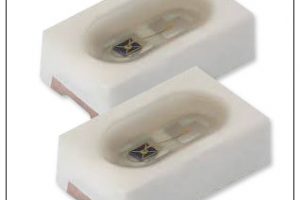
Vishay is aiming at position tracking in virtual reality headsets and augmented reality glasses with a set of surface-mount infra-red LEDs. They are: VSMY5850X01 (850nm) VSMY5890X01 (890nm) VSMY5940X01 (940nm) and deliver 30% greater radiant intensity than the firm’s prior-generation devices, and operate over -40°C to +110°C. “Ideal for position tracking in virtual or augmented reality applications, these emitters help simplify ...
Posted on 7th November 2019 | Modified on 25th June 2025
Embedded Systems, Products
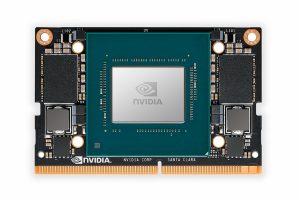
A credit card-sized supercomputer from Nvidia, the Jetson Xavier NX targets robotic and embedded computing devices at the edge. It has the performance of the company’s Xavier in the size of the Nano (70mm x 45mm), explained Rob Csongor, vice president of autonomous machines at Nvidia. “Understanding language is more complex than recognising images,” he said, explaining the choice of ...
Posted on 29th October 2019 | Modified on 19th June 2025
Automotive Electronics, EDA and IP, Embedded Systems, Products, Software
An Israeli company, Optima Design Automation has introduced two tools for automotive design. The Optima Safety platform consists of Optima-HE and Optima-SE, both based on the company’s Fault Injection Engine (FIE) and designed for fault analysis, targeting safety analysis fault injection for SoC design. The FIE uses parallel simulation and formal verification, rather than fault simulation, and introduces fault list ...
Posted on 2nd October 2019 | Modified on 2nd October 2019
EDA and IP, Embedded Systems, FPGA / PLD, Internet of Things, News, Products, Programmable Logic and Asic, Software
Xilinx embraces open source community and introduces the Vitis software platform for hardware and software development. At this year’s Xilinx Developers Forum, the company introduced the Vitis software platform, which tailors the hardware architecture to the software of algorithm code without intervention. President and CEO, Victor Peng, explained that the unified platform was developed to “empower software developers, with the ...
Posted on 17th September 2019 | Modified on 14th May 2025
EDA and IP, Embedded Systems, Industrial Electronics, Internet of Things, Microprocessors, News
The company introduced the second-generation NeuPro architecture for edge devices. NeuPro-S processors address the need to scale up its NeuPro architecture to work in heterogeneous systems, explained Yair Siegel, director of segment marketing. There are three processors available, targeting the mobile, home and automotive markets, all have safety standards enabled, added Siegel. Launched at this week’s AutoSens in Brussels, Belgium ...
Posted on 4th September 2019 | Modified on 4th September 2019
Embedded Systems, General Android, News
No desert codenames this time, the new release of Android will simply be known as Android 10.
Posted on 3rd September 2019 | Modified on 16th June 2025
EDA and IP, Embedded Systems, Research
Last week MIT announced a CPU made from carbon nano-tube (CNT) mosfets using standard CMOS fab equipment and only the materials and processes found within commercial CMOS fabs. Electronics Weekly has delved inside to see how it works. In essence, the CNT logic is CMOS, as the researchers have found a way to create p-channel CNT mosfets and n-channel mosfets with ...
Posted on 28th May 2019 | Modified on 3rd June 2019
Embedded Systems, Microprocessors, News, Products
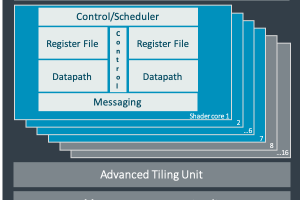
Ahead of Computex 2019 in Taiwan, Arm has announced two processors for mobile computing. The Cortex-A77 CPU and Mali-G77 GPU target mobile computing for smartphones. The Cortex-A77 increases the instructions per cycle (IPC) of the previous Cortex-A76 CPU by 20%, to improve computing performance to meet the demands of untethered AR/VR and HD gaming. The Mali-G77 is built on the ...