
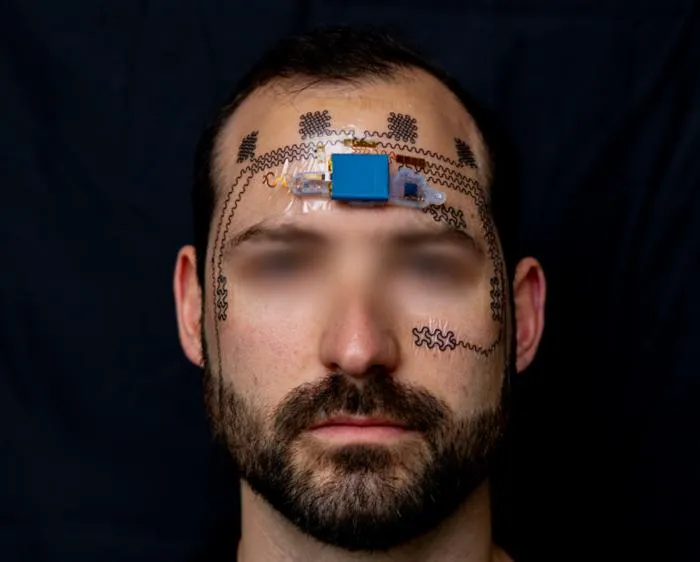
On to this is mounted an electronics package that extracts and wirelessly transmits the acquired signals.
“Unlike EEG caps that are bulky with dangling wires and lathered with gel, the wireless e-tattoo consists of a lightweight battery pack and paper-thin, sticker-like sensors,” according to Cell, which has published the research. “These sensors feature wavy loops and coils, a design that allows them to stretch and conform seamlessly to the skin for comfort and clear signals.”
The transparent ductile conductive composite PEDOT:PSS is combined with graphite-loaded polyurethane to make the electrodes, with serpentine conductors increasing the material’s stretchability to allow natural movement with the skin, and to decrease the generation of electrical motion artifacts.
Battery-powered electronics on a flexible PCB complete the assembly.
The device is intended to predict the onset of brain fatigue and combines EEG (electroencephalography) with studying eye-related signals (electrooculography – EOG).
A computer model was trained to estimate mental workload based on the sensor’s signals.
Tested on six participants performing memory challenges, the system showed higher theta and delta wave activity as cognitive demand increased, while alpha and beta activity decreased, indicating mental fatigue, according to Cell, which added: “The results suggest that the device can detect when the brain is struggling.”
The electrode array has to be made individually for each person from facial measurements and it works only on hairless skin.
“The researchers are working to combine it with ink-based sensors that work on hair. This will allow for full head coverage and more comprehensive brain monitoring,” said Cell.
The work is published as ‘A wireless forehead e-tattoo for mental workload estimation‘ in the Cell publication Device.
The National University of Singapore has also been tackling the challenges of extracting signals from dry skin.

They are WAY behind the competition that can do it WITHOUT the physical contact for more than a decade, at least.
Check the whole X thread on RF Brain Scan ( replace spaces with slashes after the “com”):
x dot com JDewarto61659 status 1889671237539930131